
Shaping Money Habits, Before They're Set: How UW Credit Union Thinks About Financial Education
What if financial education could help teens build real money skills, earn college credit, and save their families money—all before graduation?
By Anne Norman, Chief Marketing Officer
Madison, WI (September 17, 2026) - There's a specific window in teen members' lives we think about a lot. It's the stretch right before college — first job, first paycheck, maybe the first taste of managing money without a parent standing over their shoulder. It's also, for some student athletes now, the moment NIL income starts showing up. That window is exactly when financial habits start to take shape. We think it's the right moment to start teaching real money skills — not later, once those habits are already set.
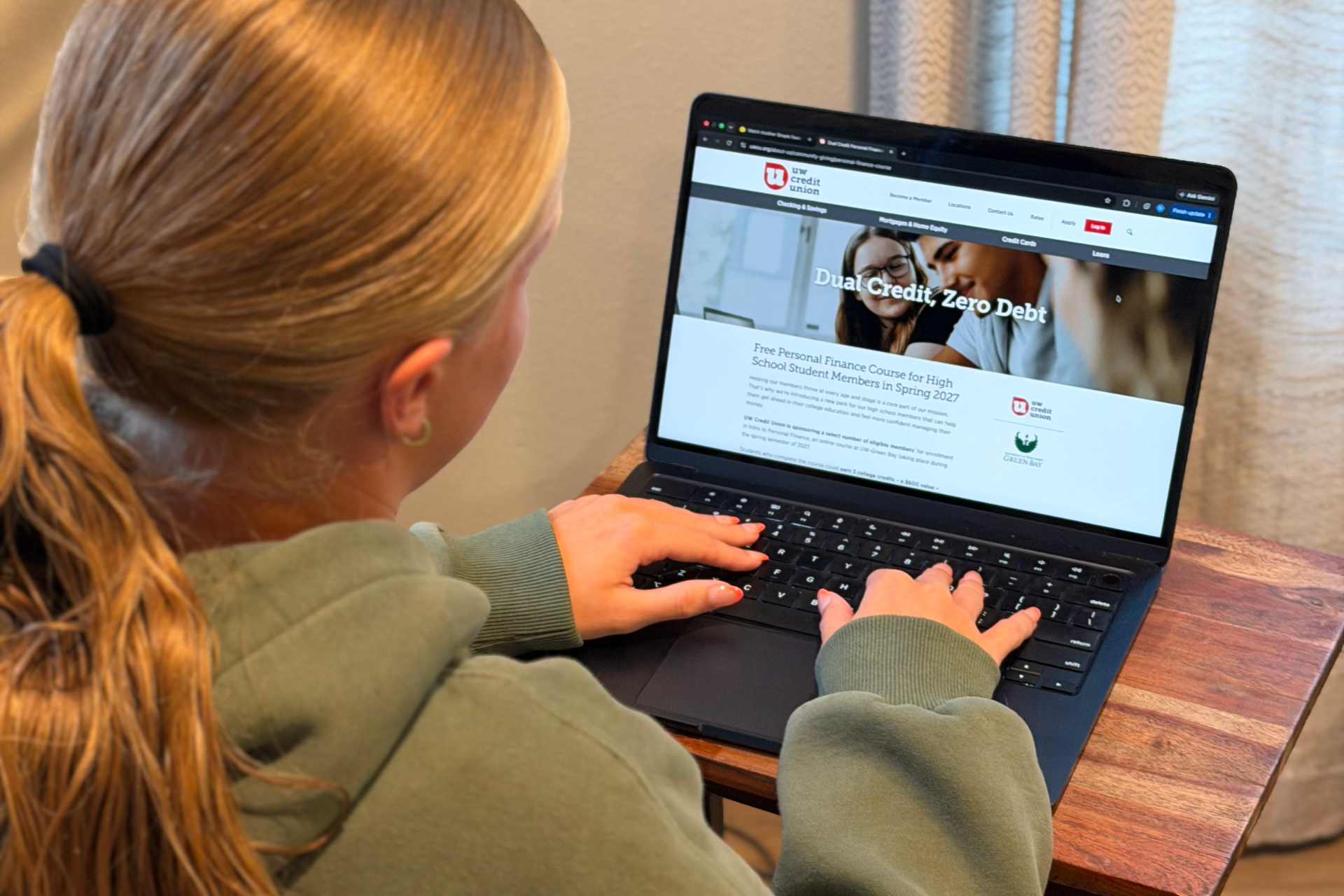
That belief is why UW Credit Union is sponsoring "Dual Credit, Zero Debt," a new partnership with UW-Green Bay that gives eligible high schoolers a free, three-credit personal finance course.
Deep roots in college success
Supporting students through college has been part of how UW Credit Union operates for a long time, not just through one program but several. We hold scholarship endowments at each of our six partner Universities of Wisconsin schools — La Crosse, Oshkosh, Whitewater, Milwaukee, Madison, Green Bay, and Madison College — administered on our behalf by each school. Since 2010, that's meant more than 500 students receiving scholarships ranging from $1,000 to $10,000. Those endowments continue today.
For over a decade, we also ran a separate program, the Community Values Scholarship: a $3,000 award for student members who showed strong academic standing and deep community involvement and was enrolled at each of our seven partner schools. From 2013 to 2025, more than 100 members received that scholarship. As of 2025, we discontinued the Community Values Scholarship. In its place, we built the UW-Green Bay partnership you're reading about now — a shift from a single, competitive award reaching a limited number of students each year to a program that can reach far more members, starting even earlier, before they've stepped foot on a college campus.
Where it came from
Wisconsin's Act 60 now requires public high schools to offer a standalone financial literacy course as a graduation requirement — and the mandate is unfunded. As the Universities of Wisconsin's leader in distance learning and dual enrollment, UW-Green Bay built a dual enrollment college course to help students meet the requirement. We saw an opportunity to help extend that course to more students than the university could reach alone, and developed this partnership together.
As part of that work, we've also been in direct conversation with the state: we recently met with Wendy Bauman, Secretary of the Wisconsin Department of Financial Institutions, to preview the course and talk through the landscape Act 60 has created for schools statewide.
Why UW-Green Bay
UW-Green Bay isn't a new relationship for us. It's our second-longest-running campus branch, dating back to 1972, behind only UW-Madison. Its strength in distance and asynchronous learning made this partnership a natural fit — the course needed to work for students juggling school, jobs, and everything else in their schedules, and that's exactly what UW-Green Bay knows how to build. It's the kind of program that benefits from a credit union with genuinely long-standing university relationships and a real stake in members' financial wellbeing.
What it means for students and families
Eligible UW Credit Union members enrolled in Wisconsin high schools can take "Introduction to Personal Finance" for free, entirely online, earn three transferable college credits (a $600 value), and satisfy their Act 60 graduation requirement — all while getting a first look at UW-Green Bay's college-readiness resources, a head start on what it actually takes to succeed in college.
A partnership that works from every direction
This is the kind of partnership where everyone involved comes out ahead. Students get a genuine head start heading into college. Families save real money and one less thing to figure out. UW-Green Bay gets to extend a course it was already building to more students than it could reach alone. And UWCU gets to deepen a more than 50-year relationship while living out something we believe: that financial confidence is built through every age and stage of life.


Related Articles

The Plaza Has Our Name on It. It Belongs to the Fans.

Two New Debit Cards, One Big Idea: Belonging
